Lipce woods
The PeasantsLipce woods are not merely a wooded edge to village life: they are a source of timber and livelihood, a focus of conflict over who may use the land, and a landscape through which the memory of violence persists. Their changing weather and surrounding fields also place human disputes within a larger cycle of natural forces that can sustain or imperil rural life.
Setting and the surrounding landscape
The woods belong to a tightly connected rural environment. The pond, roads, cottages, fields, and forest respond together to the seasons: during the cabbage harvest, rising water spills over the pond’s banks onto the lower road, while muddy lanes and rain-sodden farmyards shape the village’s daily work. The novel’s landscape is not a static backdrop. Water presses at its boundaries, and weather moves across fields and into the woods, altering the conditions under which people labor.
The onset of winter is rendered as an assault on that landscape. After the feast of St Barbara, winds race through Lipce, worry the fields and gardens, and retreat toward the forest; later gales and advancing clouds transform the woods into part of a wider scene of gathering cold. The forest offers no simple refuge from weather: it is where the winds hide before returning, while frost hardens the roads and ground around the village.
Timber, access, and village conflict
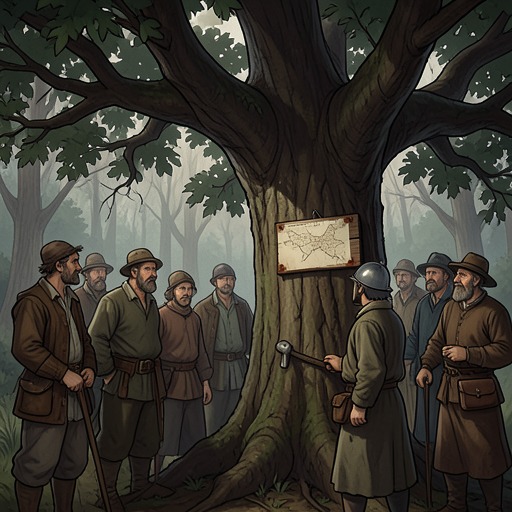
The woods become a direct political and economic concern when villagers hear that the Squire has begun felling what they regard as the peasants’ forest. The news arrives on a dark, wet day in mid-March, when the ground is thawing and sap beginning to rise. At first, villagers doubt the report because they do not expect logging to begin at that moment; although work is visible in the forest, they initially assume it must be some other task.
An earlier council discussion shows how the timber dispute gathers urgency. Szymon warns that Jewish buyers have marked the sold trees and are waiting for frost and sleighs before felling them. Boryna answers that marking the trees does not mean the cutting will go unopposed, and another villager proposes lodging a complaint with the commissioner. The exchange sets formal complaint beside the possibility of direct resistance: the forest’s trees are already implicated in a sale, but villagers contest the assumption that the sale settles their claim to the woods.
Violence and remembered history
The forest also survives in village memory as a place of injury. At the cemetery, Witek points toward graves beside the fence and says that the people buried there were beaten in the forest. Kuba confirms that his kin, including his mother, lie among them. The graves themselves are sunken and nearly erased, without crosses or shade; their obscurity contrasts with the force of Kuba’s recollection.
Kuba’s account expands that memory beyond one family. He recalls his father’s land being taken by his uncles, his own work as a boy tending the Squire’s pigs, and later service as a driver and hunter. He describes leaving with the Squire’s household, being wounded in the leg, and returning to find the manor burned and members of the household, including his mother, killed. His story does not identify every detail of the violence associated with the forest graves, but it places the villagers’ remembered losses within a longer history of service, dispossession, armed conflict, and death. The forest is thus connected to both immediate village claims and inherited memories that have not disappeared with the people who suffered them.
This local memory sits against a broader Polish history of failed uprisings and the unresolved question of peasants’ place in national life. The account of that history notes that peasants took part in uprisings even as many landowners opposed their enfranchisement. In the novel, the forest’s remembered dead make such histories intimate: political violence is recalled through kinship, unmarked graves, and the persistence of grief, rather than only through public ideals.
Seasonal hardship and narrative significance
The woods are part of an environment where the conditions of survival can change sharply. By the end of May, heat and drought wilt vegetables, dry streams, and leave potato plants barely covering the ground, while winter crops remain comparatively strong. Later, after Maciej Boryna’s death, fine warm rain falls across the fields and orchards, and the thirsty crops, drooping leaves, streams, and parched earth drink again. These scenes do not establish a specific change in the woods, but they place the forest within the same vulnerable landscape of soil, water, crops, and weather.
Lipce woods therefore gather several kinds of pressure without resolving them into one meaning. Timber makes the forest an object of economic transaction and a test of customary claims; its association with violence makes it a repository of collective and familial memory; and its place within a changing rural environment ties the villagers’ struggles to material conditions beyond any individual’s control. The dispute over the trees is consequently also a dispute over whose needs and memories count in the management of the land.